





Scientists from SAMS believe they have developed a successful tank-based method for growing a highly-valued seaweed.
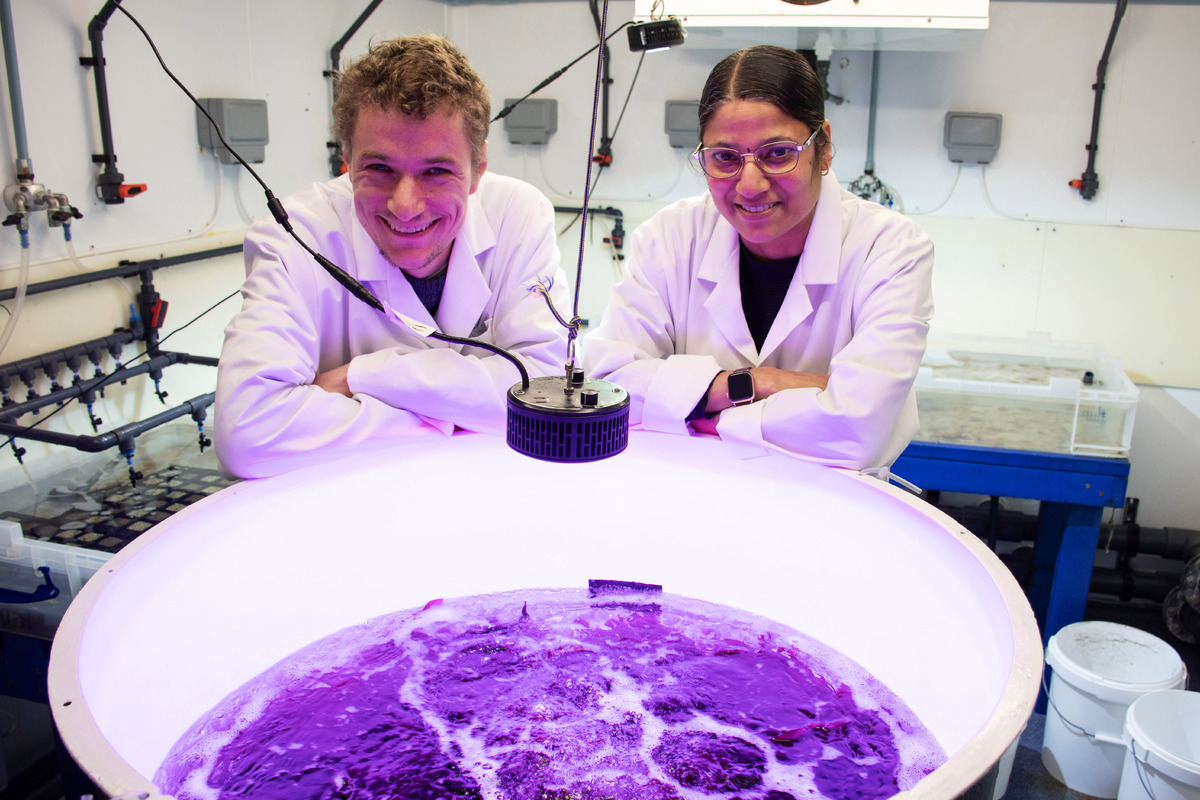
The researchers at the Scottish Association for Marine Science (SAMS) in Oban have described ‘phenomenal’ growth rates of red the seaweed Palmaria palmata, commonly known as dulse, in the institute’s aquarium, observing a doubling in biomass every week.
Palmaria palmata is consumed as a high-end food product – it is 40 times more valuable per tonne than kelp – and can be used in food, feed, dyes, cosmetics, and pharmaceuticals.
However, the species is difficult to grow and, although Palmaria palmata can be found along the Atlantic coast, natural stocks are limited. The industry has also struggled with high mortality rates at the hatchery stage, linked to infestation by disease.
The cultivation method developed at SAMS, a partner of UHI, has sought to overcome challenges in how Palmaria palmata grows. They identified a bottleneck at the problematic hatchery phase, as the species has a short reproductive window and the sexual maturity period of males and females is different, posing challenges for growers to control its life cycle.
Often, a mortality rate of 60-70 per cent is seen in spores at initial hatchery stage.
By rebalancing the microbiome by introducing natural grazers and adopting probiotic methods to limit the spread of disease, microbiologist Dr Frederik De Boever has drastically reduced mortality rates in the Palmaria palmata spores to around 10 per cent.
Watch a short film about the process below.
"The growth is phenomenal," said Dr De Boever. "We’re growing the seaweed from the spore stage to germlings, which increases resilience, compared with vegetatively cut thalli from established adult seaweeds.
"The spore to germling mortality rate is usually high but in the lab we have more control over that crucial life stage."
The demand for red seaweed is increasing but this industry primarily relies on a few seaweed species, mainly cultivated in Asian countries, that are facing threats from climate change and increasing incidences of diseases.
The combination of improved hatchery methods and tank-based cultivation has given the research team greater control over the environment, compared with open-sea farming, and a more healthy and pristine biomass with low iodine and metal accumulation. The tank-based method also allows for growing Palmaria palmata all year round.
Dr Puja Kumari, who heads up the FABRICS cultivation project at SAMS, said: "When discussing seaweed cultivation, a lot of focus is often on large kelps that generate lots of biomass, but more research effort is required to help expand and diversify the cultivation of red seaweeds in the region.
"Red seaweed cultivation is important for the seaweed aquaculture industry because it contributes to half the net worth of world seaweed production.
"There is therefore an urgent need to diversify seaweed cultivation practices to include important UK and European red seaweeds to help address the uncertainty in the red seaweed global market supply, as well as address sustainability and net zero targets."
The FABRICS project, funded by UKRI-BBSRC, also involves commercial partners W.L. Gore & Associates, Inc. in the USA and SeaDyes, a start-up based at The James Hutton Institute in Scotland that creates natural dyes from seaweed for the fashion and textile industries.
"Through our involvement in the FABRICS project, SeaDyes is working to establish a scalable and resilient supply of red seaweed biomass to underpin our sustainable dye technologies,” said Jessica Giannotti, founder and CEO of SeaDyes. "By addressing critical bottlenecks and supporting the expansion of red seaweed cultivation in Scotland, FABRICS strengthens domestic supply chains, reduces risk, and helps complete the seaweed-based value chain for downstream innovators.
"As a future off-taker of large quantities of biomass, our role in the project is to validate land-based cultivated biomass for biotechnology applications, ensuring it meets the quality, performance and scalability requirements of our bio-based dye platform."
Why not try these links to see what our West Coast AI can tell you.
(Please note this is an experimental service)
Yes! I would like to be sent emails from West Coast Today
I understand that my personal information will not be shared with any third parties, and will only be used to provide me with useful targeted articles as indicated.
I'm also aware that I can un-subscribe at any point either from each email notification or on My Account screen.