










‘Every second really counts’: Gigha helipad proves its worth in first year
More than a year after opening, Gigha’s £245,000 purpose-built helipad has proven to be a vital lifeline for the island community.


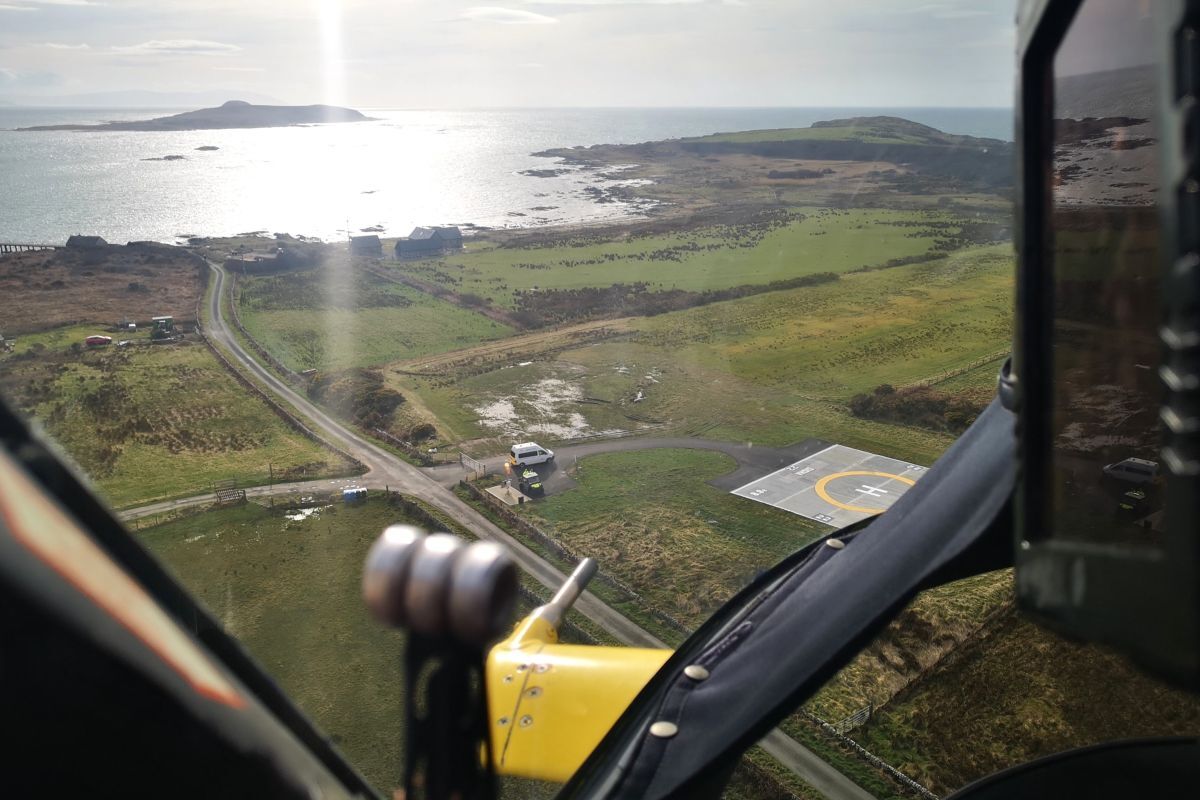
Since becoming operational in December 2024, the facility has been used about 15 times – roughly once a month. For a remote island with a population of about 200, that level of demand highlights the importance of rapid access to emergency care.
Russell Mackay, operations manager at Scotland’s Charity Air Ambulance (SCAA), described the helipad as “a real asset”.
“The Gigha helipad is great not just for us, but also for the Scottish Ambulance Service and Search and Rescue,” he said. “It’s a real asset for the islanders to have a pad of that standard in a rural and remote area.”
While air ambulance crews can land in fields or on roads when responding directly to emergencies, transferring patients between medical facilities requires a formally surveyed landing site under commercial aviation regulations, he explained.
“Having a surveyed pad with approved helipad lighting, which is maintained and safe to fly into with no obstacles, can be the difference between getting there and not – particularly during the challenging winter months,” said Mr Mackay.
Community landing sites elsewhere can include sports fields or parks, but these often lack lighting and clear approaches, making them more difficult to access safely in poor weather. A dedicated helipad provides a reliable, year-round option.
Since the start of 2020, SCAA has repatriated 57 patients by air to Campbeltown Hospital from various locations and islands, including Gigha. Cases have included trauma, strokes, cardiac arrests and inter-hospital transfers. The figure does not include patients who received time-critical treatment from SCAA clinicians but were ultimately transported to other hospitals by road.
Mr Mackay said Gigha’s helipad is well sited for transferring patients not only to Campbeltown Hospital, Glasgow’s Queen Elizabeth University Hospital and other major trauma centres but it also provides a valuable contingency when travelling to other islands.
“In poor weather, we can use it as a safe, surveyed site if we’re unable to continue elsewhere,” he said. “It’s not only an asset for the people of Gigha, but potentially for people on Islay and other islands as well.”
He added that while helicopter air ambulances are a lifeline for the islands, helipads serve as an operational lifeline for crews.
“For any island community that has the ability to install an operational surveyed helipad to that standard, it’s a real game-changer for all users,” he said.
Mr Mackay stressed that having a recognised rendezvous point known to both air and land crews can save crucial time.
“Everything we do, air ambulance-wise, is about time-critical response, where every second really counts,” he said. “When you have an agreed meeting point at a surveyed site that both the air crews and land assets know well, it’s a time-saver and a lifesaver. Sometimes it might actually be the difference between getting there and not.”
Robert Bertram, chief executive of the HELP Appeal, which funded Gigha’s helipad, said: “Just over one year on from funding the emergency helipad on Gigha, we are seeing first-hand the difference this vital infrastructure makes.”
He said air ambulance crews have been able to collect specialist medical teams from Glasgow and fly directly to patients on the island before transferring them to the Queen Elizabeth University Hospital within around half an hour.
“Without the helipad, that journey would have involved complex road and ferry transfers, costing precious time,” he said.
“This is exactly why we funded this helipad and the helipads in Applecross, Isle of Mull and Isle of Skye, with our next planned project on Arran – to ensure rapid emergency care and give island communities the same chance of survival as those on the mainland.
“Delivered alongside the Corps of Royal Engineers, the Gigha helipad was the first project of its kind in the country. It stands as a powerful example of what can be achieved through partnership and shared commitment.
“Building on that success, we are keen to support further helipad projects to improve emergency access for remote and rural communities, ensuring help can arrive quickly when it is needed most.”
Serving almost 100 inhabited islands as well as mainland communities across Scotland, SCAA is a charity funded entirely by public donations.
“Our ambition is that no one in Scotland should die because help can’t get there in time,” said Mr Mackay. “We’ve completed more than 7,000 missions, and none of that is possible without the generous support of the people of Scotland.”
Visit www.scaa.org.uk/donate-now to support SCAA’s lifesaving work.
Why not try these links to see what our West Coast AI can tell you.
(Please note this is an experimental service)
Latest News
JOBS
Early Learning and Childcare (ELC) Practitioner - Riverside Rascals Nursery
Sign up to our daily Newsletter
Permission Statement

Yes! I would like to be sent emails from West Coast Today
I understand that my personal information will not be shared with any third parties, and will only be used to provide me with useful targeted articles as indicated.
I'm also aware that I can un-subscribe at any point either from each email notification or on My Account screen.
You may also like


Latest News
JOBS
Early Learning and Childcare (ELC) Practitioner - Riverside Rascals Nursery
Sign up to our daily Newsletters
Permission Statement
Yes! I would like to be sent emails from West Coast Today
I understand that my personal information will not be shared with any third parties, and will only be used to provide me with useful targeted articles as indicated.
I'm also aware that I can un-subscribe at any point either from each email notification or on My Account screen.



© 2026 Wyvex Media Limited.